
You are here
Minerals will continue to drive African economies: A view from Mining Indaba in Cape Town
Every second week of February, downtown Cape Town turns into a milling sea of humanity as serious looking chiefs of mining companies, those of their suppliers, and other personalities closely related to the industry stream from one lecture hall to the other and one exhibition to the next in search of new ideas, new machines, and new sources of financing. This has been the case also for the 2015 edition of the global mining forum, Mining Indaba.
Tony Blair, the former British Prime Minister, was lined up by the organizers as a speaker for the main stage, as were a number of high-ranking bankers and businessmen and -women. Many South African politicians also made an appearance, as the opening of Parliament was also taking place the same week. Hundreds of companies, including all the leading mining giants had put their wares on display – from new ICT approaches, to lamps for the underground, and giant caterpillar equipment for levelling mountains.
In the light of this hustle and bustle, in the bazaar atmosphere of the International Conference Center of Cape Town, one could only conclude that in spite of the recent decline of commodity prices and the shine off gold and diamonds, investors, governments and other stakeholders were still very excited about the prospects for Africa's mining industry. Indeed, many experts talked about the great prospects ahead – convinced that the upturn was not far off and that it would be strong. Some even welcome the price decline as a form of respite allowing for recalibration and allowing the industry to return to basics, to get back its "mojo" so to speak.
This was the background for the two well-attended seminars coordinated by the African Development Bank’s African Natural Resources Centre: the first, a presentation by the AfDB and the Bill and Melinda Gates Foundation on "Maximizing the Impact of Extractives for Human Development", the product of joint work initiated in 2014, and the second a debate on "Shared Resources, Shared Values, and Shared Benefits" organized by the Bank on its own.
In the largely business-oriented atmosphere of Mining Indaba, the formal and fairly deep discussions of the aspirations and challenges facing the extractives industry across Africa proved to be both an eye-opener and a good indicator of what lies ahead for the industry, at least from the point of view of participants. The issue of how best to share the wealth and benefits from the continent’s rich natural resources has now become an ingrained part of the dialogue. But in reality there is no quick fix. Mining ventures require scale and capital to be competitive. In good times, governments would tend to want to raise their share of the profits, but often do not compensate producers during difficult times. This asymmetry, in an industry prone to sharp fluctuations, leads to creative solutions on the part of mining companies and their shareholders. "Shared" values and benefits sometimes sound to the mining conglomerates as words from a bully pulpit. However, mining companies realize that they can no longer operate without exercising a modicum of corporate responsibility – for many, the challenge today is how to do this and still make money. Mining Indaba 2015 showed that the spirit of the industry is far from broken.
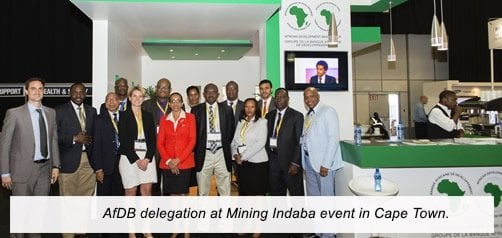
The Bank's participation at Mining Indaba once again demonstrated the "One Bank" approach. The African Natural Resources Centre planned and coordinated the two events, bringing in the African Legal Support Facility, the Front Office of Sector Operations, the Research Department, and myself as the Acting Chief Economist and Vice-President.
The Bank's booth was well attended with many participants stopping by to pick up literature, and to ask questions about the Bank and its operations in Africa. The concept proved to be an innovative means of disseminating the Bank's work and of influencing policy in a subtle but effective manner.