
You are here
Infrastructure
Building climate-resilient infrastructure in Africa: challenges and opportunities
A few days ahead of the opening of COP 29 in Baku, Azerbaijan, devastating hurricanes Milton and Helene in Florida (USA), floods in the countries of the Sahel and Spain, not to mention ongoing droughts in southern Africa all serve to remind the international community of the urgent need for action.
We must safeguard the gains of development. These extreme climatic events cause enormous losses and damage to economies, and particularly infrastructure.
Championing Inclusive Growth Across Africa
For the past decade, Africa has exhibited strong economic growth. A new economic growth momentum has been established. The continent weathered the financial crisis and has bounced back. But headline economic growth is not enough. Deliberate policies to reduce inequalities and promote inclusion are now needed more than ever before. It is time to focus on people’s expectations: decent work, a living wage, access to basic service, more democracy, and accountable governments. Africa and its people aim to be a pole for global growth in the decades ahead.
Mergers and Acquisitions in Africa
In recent years, mergers and acquisitions (M&A) activities have become an important channel for investment in Africa for both global and local market players. M&A deals have allowed companies to consolidate their positions in African markets, contributing to better market access and competitiveness.
Mining Industry Prospects in Africa
The mining industry worldwide is undergoing unprecedented changes, including high volatility of commodity prices and rising exploration costs. Africa, which produces more than 60 metal and mineral products, has a huge potential with respect to mineral reserves exploration and production.
The High Cost of Electricity Generation in Africa
Africa’s power sector is facing many challenges, mainly due to insufficient generation capacity which has limited electricity supply, resulting in low access. The main obstacle to the increase in electricity generation capacity is the high cost of producing electricity, forcing governments to subsidize consumption. In 2010, the average effective electricity tariff in Africa was US $0.14 per kilowatt-hour (kWh) against an average of US $0.18 per kWh in production costs. Consumption is effectively subsidized, but with significant disparities among African countries.
Improved Infrastructure to Support Africa’s Competitiveness
Compared with other regions, African countries have a low stock of infrastructure, particularly in energy and transportation, and the potential for information and communication technologies (ICTs) has not been fully harnessed. This pronounced infrastructure deficit, coupled with burdensome trade regulations, has raised the cost of doing business and constrained domestic productivity. It also presents a critical bottleneck to regional integration. Today, African countries are among the least competitive economies in the world.
Multilateral aid for the 21st Century
Africa’s mineral wealth: A blessing or a curse?
The question is so often asked, and about so many of the determinants of development on the continent of Africa.
Getting it right in the Sahel
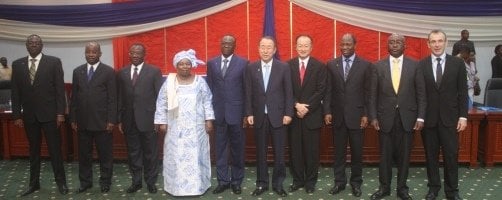
Last week I joined UN Secretary-General Ban Ki-moon, World Bank President Jim Yong Kim, African Union Commission Chair Nkosazana Dlamini-Zuma and EU Commissioner for Development Andris Piebalgs on a visit to the Sahel region.
It was a first.
Africa and America in Washington: How far have we got?
50 Africa leaders convene in Washington for a historic meeting with President Obama this week. Pedestrians and motorists caught up in the inevitable traffic jams around the White House may well be asking how far they have got, and where they are heading.